
Innovation in Physical Therapy
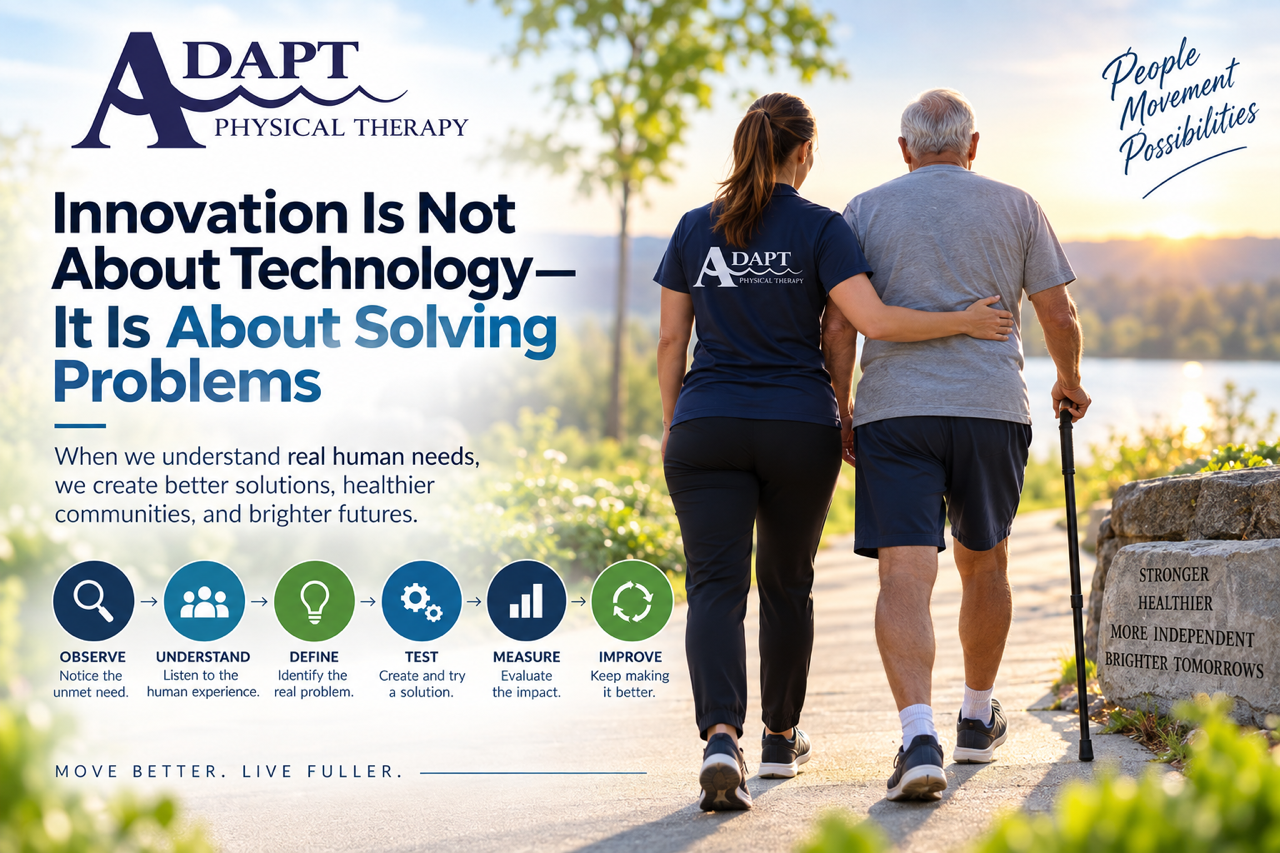
Innovation Is Not About Technology—It Is About Solving Problems
How Recognizing an Unmet Human Need Can Transform Healthcare, Physical Therapy, Business, and Everyday Life
By ADAPT Physical Therapy
When most people hear the word innovation, they immediately picture technology.
Artificial intelligence. Robotics. Smartphone applications. Virtual reality. Wearable sensors. Advanced imaging. Automated machines.
Technology certainly can be innovative. But technology itself is not innovation.
Innovation begins with a problem.
More specifically, it begins when someone pays enough attention to recognize that a human need is not being adequately met—and then asks:
“Is there a better way?”
That question has changed medicine, transportation, communication, education, business, and almost every aspect of modern life.
It is also highly relevant to physical therapy.
A patient struggling to climb stairs does not necessarily need a more sophisticated machine. The patient needs a way to climb stairs safely.
A person recovering from joint replacement does not primarily need technology. That person wants to walk independently, sleep with less discomfort, return to work, play with grandchildren, or get back to a favorite activity.
An older adult who is afraid of falling does not simply need a balance test. That person needs confidence and the physical capacity to move safely through everyday life.
A worker with back pain may not be searching for a complicated medical intervention. He or she may simply need to understand why the pain developed, how to move safely, how to become stronger, and how to prevent the problem from recurring.
That distinction matters.
At ADAPT Physical Therapy, we believe some of the most meaningful innovation in healthcare begins not with asking what technology is available, but with asking:
What does this person need to be able to do that they cannot comfortably or safely do today?
That is human-centered innovation.
And in many ways, it represents the future of healthcare.
The Real Definition of Innovation
Innovation and invention are related, but they are not identical.
An invention creates something new.
Innovation creates a better way of solving a meaningful problem.
Sometimes the solution involves sophisticated technology. Sometimes it involves changing a process. Sometimes it means reorganizing a service around the patient. And sometimes the innovation is remarkably simple.
Consider some familiar examples.
The rolling suitcase did not require revolutionary science. Someone recognized that travelers were unnecessarily carrying heavy luggage when wheels could do much of the work.
Online banking did not change the fundamental purpose of banking. It solved the inconvenience of having to visit a branch for routine transactions.
Telehealth did not invent communication between clinicians and patients. It created another way for that communication to occur when distance, transportation, illness, scheduling, or mobility made an office visit difficult.
Automatic doors solve a small but important accessibility problem for people using wheelchairs, walkers, crutches, strollers, or carrying objects.
The common denominator is not technology.
It is friction.
Something was unnecessarily difficult, expensive, inconvenient, unsafe, inaccessible, or inefficient. Someone noticed the problem and redesigned the experience.
That is where innovation begins.
Healthcare Has No Shortage of Problems Worth Solving
Healthcare is one of the most technologically advanced industries in the world.
We can perform robotic surgery, replace damaged joints, implant artificial heart valves, sequence genomes, visualize structures deep inside the human body, and use sophisticated algorithms to analyze enormous quantities of medical information.
Yet patients can still struggle with remarkably basic problems.
They may have difficulty getting an appointment.
They may not understand their home exercise program.
They may have trouble finding transportation to therapy.
They may leave a medical encounter without fully understanding what is wrong.
They may receive technically successful surgery but remain weak, fearful, or unable to resume normal activities.
They may receive several treatments directed at pain without anyone adequately addressing the functional problem behind the pain.
This illustrates an important principle:
Technological advancement does not automatically produce a better patient experience or a better functional outcome.
True healthcare innovation therefore requires us to look beyond the disease and understand the person living with it.
The World Health Organization defines rehabilitation around optimizing functioning and reducing disability. WHO estimates that approximately 2.4 billion people worldwide live with health conditions that could benefit from rehabilitation, and the need is expected to continue increasing as populations age and chronic diseases become more prevalent. (World Health Organization)
That statistic is extraordinary.
It means rehabilitation is not a small specialty serving a limited population.
Approximately one out of every three people worldwide may have a condition that could benefit from rehabilitation. (World Health Organization)
The challenge before healthcare, therefore, is not simply to develop more sophisticated treatments.
It is to find better ways to help people function.
Physical Therapy Is Problem-Solving in Action
Physical therapy provides an excellent example of human-centered innovation because the profession is fundamentally built around solving functional problems.
A physical therapist does not simply ask:
“Where does it hurt?”
The more meaningful questions are often:
What can you no longer do?
What activity causes difficulty?
When did the problem begin?
What movements make it better or worse?
Are you becoming weaker?
Are you afraid of falling?
Can you get out of a chair without using your arms?
Can you climb stairs?
Can you walk far enough to shop for groceries?
Can you return to work?
Can you get into your car?
Can you reach a kitchen cabinet?
Can you lift your child or grandchild?
Can you return to gardening, golf, hunting, running, or another activity you enjoy?
These questions transform treatment from a diagnosis-centered process into a person-centered problem-solving process.
Two patients can have the same medical diagnosis but completely different needs.
Consider two people with knee osteoarthritis.
One may want to walk comfortably through a grocery store.
Another may want to return to recreational golf.
A third may need to climb stairs at work.
A fourth may simply want to get up from the floor safely after playing with grandchildren.
The diagnosis is the same.
The problem is different.
Therefore, the solution should not automatically be identical.
That is one of the most important lessons innovation can teach healthcare.
The Best Innovation Often Begins With Better Questions
There is a tendency in medicine to start with solutions.
Should we order an MRI?
Should we prescribe medication?
Should we perform an injection?
Should we use a particular machine?
Should we consider surgery?
Those may all be appropriate questions in the right circumstances.
But innovative thinking starts earlier.
It asks:
What problem are we actually trying to solve?
Imagine a patient experiencing chronic back pain.
The obvious problem appears to be pain.
But deeper evaluation may reveal several interacting problems:
The patient has become afraid of movement.
Physical activity has decreased.
Core and lower-extremity strength have declined.
The patient has stopped exercising.
Workstation ergonomics are poor.
Sleep has deteriorated.
The patient believes movement will cause further damage.
Now the problem is no longer simply “back pain.”
It is a complex interaction among pain, movement, strength, behavior, confidence, environment, and daily function.
That understanding changes the treatment strategy.
Early Physical Therapy: An Example of Process Innovation
Innovation does not always mean inventing a new treatment.
Sometimes it means delivering an established treatment at a better time.
Low back pain provides an important example.
A large national retrospective study examined nearly 980,000 U.S. adults with acute low back pain. Approximately 11% received physical therapy within two weeks.
Early physical therapy was associated with lower odds of emergency department visits, advanced imaging, pain-specialist visits, orthopedic visits, and epidural steroid injections during the first 30 days. Early PT was also associated with lower 30-day low-back-pain-related spending. (PubMed)
Another study of more than 32,000 patients found that, among patients receiving physical therapy for low back pain, early PT was associated with decreased subsequent use of advanced imaging, surgery, injections, additional physician visits, and opioid medication compared with delayed physical therapy. (PubMed)
A systematic review examining early versus delayed physical therapy for acute low back pain similarly concluded that early PT may reduce subsequent healthcare utilization, costs, opioid use, spine injections, and surgery, although results vary depending on the comparison group and patient population. (PubMed)
This distinction is important.
The evidence does not mean that every person with back pain requires immediate physical therapy, nor does it prove that PT alone caused every reduction observed in claims-based studies.
It does demonstrate something important about innovation:
Changing when and how patients enter the healthcare system may sometimes be as important as inventing another treatment.
That is process innovation.
Innovation Can Mean Moving From Passive Care to Active Recovery
Another important innovation in rehabilitation has been the growing emphasis on active participation.
Patients understandably want relief from pain.
But the long-term goal of rehabilitation is usually larger than temporarily decreasing symptoms.
We want people to regain the ability to manage their bodies and their lives.
That may involve progressive strengthening, mobility training, balance exercises, endurance training, education, activity modification, neuromuscular retraining, and an individualized home exercise program.
Consider osteoarthritis.
For decades, many people with arthritis were afraid that exercise would further damage painful joints.
Modern evidence has changed that conversation.
The American College of Rheumatology and Arthritis Foundation strongly recommend exercise for people with knee, hip, and hand osteoarthritis. Their guideline recognizes multiple appropriate approaches, including walking, strengthening, cycling, neuromuscular exercise, and aquatic exercise. (American College of Rheumatology)
That represents an important conceptual innovation.
Instead of simply telling someone with arthritis:
“Your joint is worn out. Avoid using it.”
The modern rehabilitation question becomes:
“How can we help you move safely, become stronger, manage symptoms, and continue participating in life?”
That is a very different philosophy.
Aquatic Therapy: Innovation by Changing the Environment
Sometimes the patient is willing to exercise, but gravity makes exercise difficult.
That creates another problem worth solving.
A person may need strengthening and movement but experience substantial discomfort with weight-bearing exercise on land.
One solution is not necessarily to abandon exercise.
It may be to change the environment in which exercise occurs.
That is one of the principles behind aquatic therapy.
Water provides buoyancy, allowing some individuals to practice movements and exercises in a lower-impact environment. Aquatic exercise can incorporate aerobic activity, joint range-of-motion work, strengthening, and functional movement. It is recognized among exercise approaches used in osteoarthritis management. (American College of Rheumatology)
The innovative idea is simple:
If a person has difficulty exercising against full body weight, modify the environment so movement becomes more achievable.
The swimming pool is not the innovation by itself.
The innovation is recognizing the barrier and finding another way around it.
Preventing Falls: Solving the Problem Before the Injury
Some of the most powerful innovations in healthcare occur before a catastrophic event.
Falls among older adults are a good example.
According to the CDC, more than 14 million Americans age 65 and older—approximately one in four older adults—report falling each year. About 37% of those who fall report an injury requiring medical treatment or restricting activity for at least one day. (CDC)
The consequences can be substantial.
The CDC reports approximately 3 million emergency-department visits and about 1 million hospitalizations among older adults related to falls annually. (CDC)
Traditional healthcare often becomes involved after the fall:
A fracture occurs.
An ambulance is called.
Imaging is performed.
Surgery may be necessary.
Hospitalization follows.
Rehabilitation begins afterward.
But innovation asks a different question:
Could we identify the risk before the fall happens?
Physical therapy can contribute to this problem-solving approach by evaluating factors such as strength, balance, gait, mobility, functional transfers, and confidence with movement, while the broader healthcare team can address medications, vision, footwear, home hazards, and medical factors associated with falls.
The goal shifts from treating the consequence to reducing the risk.
That is preventive innovation.
Innovation Is Also Personalization
Modern society has become increasingly personalized.
Our phones learn our preferences.
Streaming services recommend programs based on viewing history.
Navigation systems calculate routes based on current conditions.
Yet healthcare has historically relied heavily on standardized approaches.
Standardization has tremendous value. Clinical guidelines, protocols, and evidence-based pathways help improve quality and safety.
But patients are not standardized products.
A 35-year-old construction worker recovering from ACL surgery does not have the same functional goals as a 78-year-old recovering from a total knee replacement.
A marathon runner with Achilles pain does not have the same rehabilitation goals as a sedentary individual with the same diagnosis.
An exercise program that is scientifically sound but impossible for a patient to perform consistently is not an effective solution.
Even osteoarthritis guidelines emphasize the importance of patient preference and access when selecting exercise because adherence depends partly on whether an activity is practical and acceptable to the individual. (American College of Rheumatology)
The innovative question therefore becomes:
What intervention is most likely to work for this particular person in this particular life?
Personalization does not mean abandoning evidence.
It means applying evidence intelligently.
Data Should Support Innovation—Not Replace Human Judgment
Healthcare is generating more data than at any point in history.
Electronic medical records, wearable devices, imaging systems, motion sensors, patient-reported outcome measures, and artificial intelligence can provide enormous amounts of information.
That can be extremely valuable.
But data alone cannot determine what matters most to a person.
A computer may measure walking speed.
A clinician needs to understand why walking matters to the patient.
A device may count steps.
A conversation may reveal that the patient wants enough endurance to attend a granddaughter’s graduation.
A balance test may identify fall risk.
A thoughtful discussion may reveal that fear of falling has caused someone to stop leaving the house.
Innovation happens when objective information and human understanding work together.
The best healthcare technology should therefore not replace the relationship between clinician and patient.
It should strengthen our ability to solve the patient’s problem.
Movement Itself Is a Powerful Innovation
One of the most underappreciated tools in healthcare requires no electricity, software subscription, or sophisticated equipment.
Movement.
The U.S. Physical Activity Guidelines recommend that adults work toward 150–300 minutes of moderate-intensity aerobic activity each week, along with muscle-strengthening activities on at least two days per week, for substantial health benefits. (Health.gov)
Yet telling someone to “exercise more” is rarely enough.
The real problem may be:
Pain prevents walking.
Weakness makes stairs difficult.
Poor balance creates fear.
A recent operation limits activity.
The patient does not know which exercises are safe.
Previous attempts at exercise caused symptoms.
The person lacks confidence.
This is where physical therapy can function as a bridge between a public-health recommendation and an individual’s reality.
The recommendation may be 150 minutes.
But innovation asks:
How do we help this particular person safely progress from where they are today toward greater activity tomorrow?
Perhaps the starting point is not 30 minutes of walking.
Perhaps it is five minutes.
Perhaps it is seated exercise.
Perhaps it is aquatic therapy.
Perhaps it is balance training.
Perhaps it is learning how to stand from a chair independently.
Progress begins with the problem in front of us.
Business Innovation Works the Same Way
The same principle extends far beyond healthcare.
Businesses sometimes believe innovation means creating a new product.
But many successful businesses grow because they remove friction from an existing experience.
Customers rarely wake up wanting “innovation.”
They want:
Less waiting.
Simpler scheduling.
Clearer communication.
Better access.
Reliable service.
Transparent pricing.
Faster answers.
Greater convenience.
Better outcomes.
The business that understands those unmet needs can innovate without inventing anything revolutionary.
Healthcare organizations should think similarly.
Instead of asking:
“What new service can we sell?”
A more useful question may be:
“What makes receiving care unnecessarily difficult for our patients?”
Maybe scheduling is complicated.
Maybe patients do not understand their insurance.
Maybe transportation is difficult.
Maybe instructions are confusing.
Maybe communication between providers is fragmented.
Maybe a rural community lacks convenient rehabilitation services.
Every frustration represents information.
Every recurring complaint represents data.
And every unnecessary obstacle represents an opportunity to innovate.
Everyday Innovation: Notice the Friction
Innovation is not reserved for scientists, engineers, physicians, entrepreneurs, or technology companies.
Every person can think innovatively.
Start by noticing friction.
When something repeatedly causes frustration, ask why.
When people repeatedly make the same mistake, ask whether the process is poorly designed.
When someone cannot perform an activity, ask whether the environment can be modified.
When a task requires unnecessary steps, ask whether those steps can be removed.
When a patient does not follow instructions, do not immediately assume noncompliance. Ask whether the instructions were understandable, realistic, affordable, accessible, and compatible with that person’s life.
Innovation often begins with curiosity rather than expertise.
A useful formula is:
Observe → Understand → Define the problem → Test a solution → Measure the result → Improve again.
That final step matters.
Innovation is rarely perfect on the first attempt.
It evolves.
Sometimes the Most Innovative Decision Is to Keep Things Simple
Healthcare can become fascinated with complexity.
But more complex does not automatically mean more effective.
If a simple intervention solves the problem safely and effectively, adding complexity may increase cost without adding meaningful value.
This principle is especially important in rehabilitation.
A sophisticated piece of equipment may be useful.
But so can a chair.
A staircase.
A resistance band.
A swimming pool.
A hallway.
A patient’s own body weight.
The value of an intervention should not be judged by how technologically impressive it appears.
It should be judged by whether it helps achieve the desired outcome.
Can the patient walk farther?
Can the patient get out of bed?
Can the patient return to work?
Can the patient climb stairs?
Can the patient regain strength?
Can the patient participate more fully in life?
That is the outcome that matters.
Technology Still Matters—When It Serves the Problem
None of this is an argument against technology.
Technology has transformed healthcare and will continue to do so.
Artificial intelligence may help clinicians analyze information.
Wearable sensors may help monitor movement.
Telehealth may improve access.
Robotic systems may assist rehabilitation.
Virtual reality may create new therapeutic environments.
Digital tools may improve communication and adherence.
But the order matters.
Poor innovation starts with technology and searches for a reason to use it.
Good innovation starts with a meaningful problem and asks whether technology can help solve it.
Problem first. Technology second.
That simple distinction can prevent enormous amounts of wasted effort and expense.
What Innovation Means at ADAPT Physical Therapy
For us, innovation in physical therapy does not mean chasing every new device or trend.
It means continually asking how rehabilitation can better serve the person in front of us.
It means combining clinical knowledge, evidence, appropriate technology, therapeutic exercise, patient education, hands-on care when appropriate, aquatic therapy where clinically suitable, and individualized progression around one central objective:
helping people move and function better.
Sometimes the innovative solution may involve advanced equipment.
Sometimes it may involve water.
Sometimes it may involve changing an exercise.
Sometimes it may involve identifying a fall risk.
Sometimes it may involve teaching a patient why movement is safe.
Sometimes it may involve recognizing that the patient’s real goal is not simply decreasing a pain score from seven to three.
The real goal may be attending church again.
Returning to work.
Walking through the woods.
Getting back on a motorcycle.
Playing with grandchildren.
Gardening.
Golfing.
Running.
Sleeping comfortably.
Living independently.
That is why we must never allow healthcare to become so focused on diagnoses, procedures, and technology that we forget the person behind the medical record.
The Future of Healthcare Is Human-Centered
The healthcare system of the future will undoubtedly contain more technology.
We will see better artificial intelligence, more sophisticated robotics, improved wearable sensors, more precise imaging, remote monitoring, personalized medicine, and technologies we cannot yet imagine.
But the central question of healthcare will remain remarkably simple:
What does this person need?
Technology may change.
Human needs remain.
People want to move.
They want independence.
They want dignity.
They want to participate in family life.
They want to work.
They want to remain active.
They want to recover after illness or injury.
They want to age without unnecessarily losing their independence.
WHO’s estimate that roughly one-third of the world’s population lives with a condition that could benefit from rehabilitation reminds us of the enormous scale of this challenge. (World Health Organization)
Meeting that challenge will require science.
It will require skilled clinicians.
It will require technology.
But above all, it will require people who are willing to notice unmet needs and ask better questions.
Innovation Begins With One Question
The next great innovation in healthcare may be an artificial-intelligence system.
It may be a surgical robot.
It may be a new rehabilitation device.
But it could also be something much simpler.
It could be a therapist recognizing why a patient keeps falling.
A clinician realizing why someone has stopped exercising.
A healthcare organization making rehabilitation easier to access.
A therapist finding another way for a patient with arthritis to exercise comfortably.
A family modifying a home so an older adult can remain independent.
Or a patient discovering that an activity once considered impossible can gradually become possible again.
That is innovation.
Innovation is not defined by how advanced the technology is.
It is defined by how meaningful the problem is—and how effectively we solve it.
At ADAPT Physical Therapy, that is the kind of innovation that matters most.
Because ultimately, healthcare innovation should not be measured by the number of machines we purchase, applications we develop, or technologies we adopt.
It should be measured in human outcomes:
More movement.
More independence.
More confidence.
Less disability.
Better function.
And a better quality of life.
That is where innovation becomes meaningful.
Evidence Base & Further Reading
This article draws on evidence and guidance from the World Health Organization, Centers for Disease Control and Prevention, U.S. Department of Health and Human Services, peer-reviewed physical therapy research indexed by PubMed, and the American College of Rheumatology/Arthritis Foundation. Key evidence includes WHO’s global estimates of rehabilitation need; CDC data on older-adult falls; U.S. Physical Activity Guidelines; clinical guidelines supporting exercise for osteoarthritis; and research examining timing of physical therapy and downstream healthcare utilization in low back pain. (World Health Organization)
Medical Disclaimer: This article is intended for general educational purposes and does not replace individualized medical evaluation, diagnosis, or treatment. Symptoms such as severe or progressive weakness, significant trauma, unexplained systemic symptoms, loss of bowel or bladder control, chest pain, difficulty breathing, or other concerning changes require appropriate medical evaluation.