
Falls Are Not a Normal Part of Aging
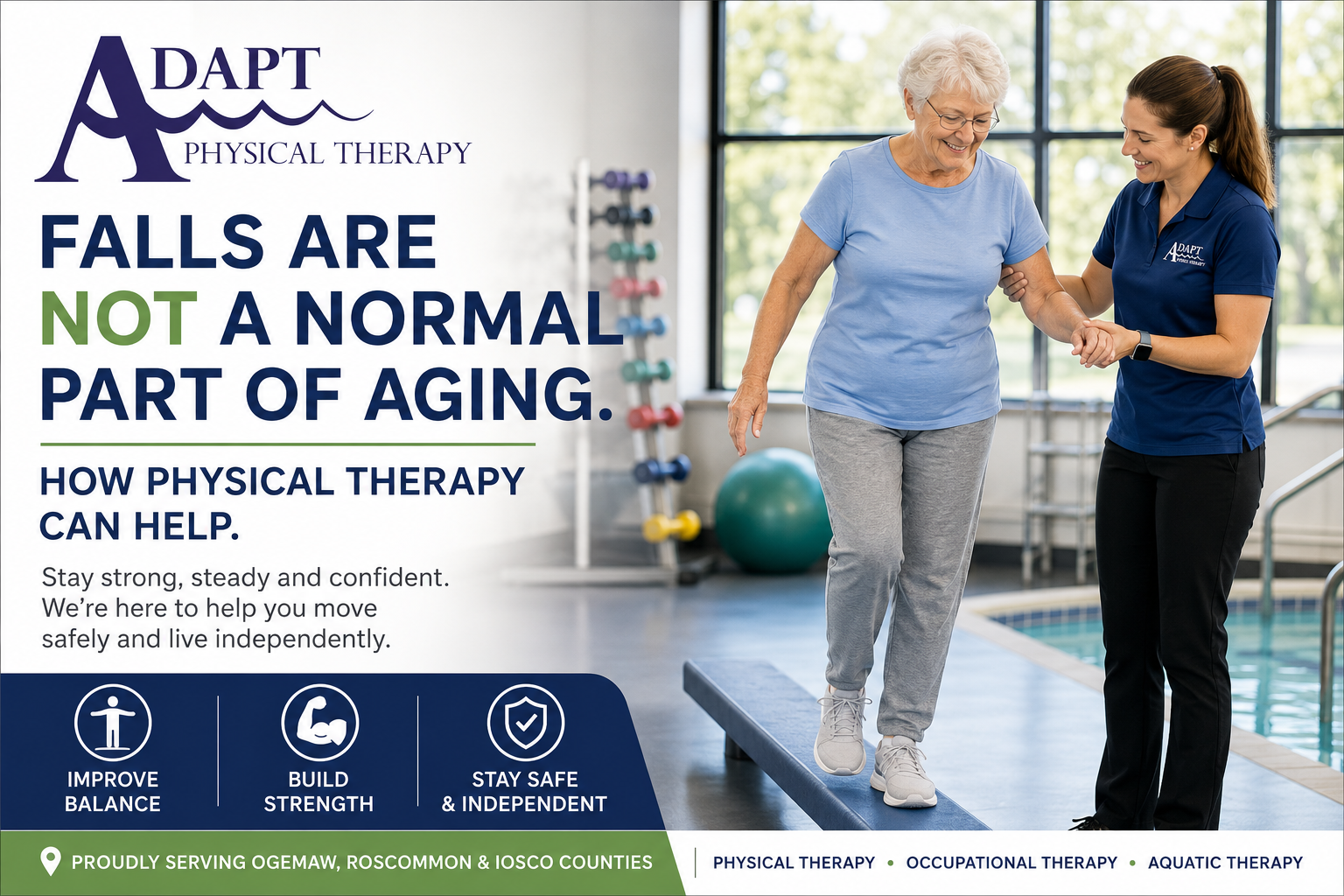
How ADAPT Physical Therapy Can Help
By Adapt Physical Therapy
Getting older may bring changes in strength, flexibility, vision, and balance—but falling should not simply be accepted as a normal part of aging.
A fall can happen in a matter of seconds, but its consequences can last for months or even years. For an older adult, a fall may lead to a fracture, hospitalization, loss of confidence, reduced mobility, or difficulty living independently.
The encouraging news is that many falls can be prevented.
At Adapt Physical Therapy, we believe that maintaining strength, balance, mobility, and confidence is an important part of healthy aging. Physical therapy can help identify factors that may increase your risk of falling and develop an individualized program to help you move more safely.
Falls Are Common—but They Are Not Inevitable
According to the National Institute on Aging, more than one in four adults age 65 and older falls each year. The Centers for Disease Control and Prevention emphasizes that falls can be prevented and that there are proven ways for older adults to reduce their risk.
A common mistake is thinking:
“I’m getting older. Losing my balance is just something I have to live with.”
That isn’t necessarily true.
While certain physical changes become more common with age, many of the factors contributing to falls can be addressed.
These may include:
- Reduced leg strength
- Poor balance
- Changes in walking pattern
- Decreased flexibility
- Reduced endurance
- Difficulty getting up from a chair
- Dizziness or vestibular problems
- Vision changes
- Certain medications
- Improper use of a cane or walker
- Unsafe footwear
- Environmental hazards in the home
- Fear of falling
Recognizing these problems early can provide an opportunity to take action before a serious fall occurs.
Why Falls Can Be So Serious
For a younger person, a fall may result in little more than embarrassment or a bruise. For an older adult, the consequences can be much more significant.
Falls can result in injuries such as fractures and can sometimes lead to hospitalization, disability, or loss of independence.
Hip fractures are of particular concern. The CDC notes that broken hips are among the most serious fall-related injuries and that recovery can be difficult.
But there is another consequence of falling that receives less attention:
The fear of falling again.
After experiencing a fall, some people begin avoiding activities they once enjoyed.
They may stop taking walks.
They may avoid shopping.
They may stop visiting friends.
They may become nervous about stairs.
They may begin relying on family members for activities they previously performed independently.
Unfortunately, becoming less active can contribute to further weakness and decreased balance—potentially creating a cycle of:
Fall → Fear → Less Activity → Weakness → Greater Fall Risk
The goal of rehabilitation is not simply to prevent another fall. It is also to help people maintain the confidence and physical ability to continue participating in life.
How Physical Therapy Can Help Prevent Falls
Physical therapists are trained to evaluate movement, strength, balance, walking ability, and functional mobility.
A fall-prevention physical therapy evaluation may look at several areas.
1. Balance
Balance is a complex interaction between your muscles, joints, vision, inner ear, nervous system, and brain.
A physical therapist can assess how well you maintain your balance while standing, walking, turning, reaching, and performing everyday activities.
Treatment may then include exercises designed specifically to challenge and improve your balance safely.
2. Leg Strength
Strong legs are important for much more than walking.
You need adequate strength to:
- Rise from a chair
- Climb stairs
- Step over obstacles
- Get in and out of a vehicle
- Walk on uneven ground
- Recover when you lose your balance
Loss of muscle strength can make these everyday activities increasingly difficult.
A personalized strengthening program may focus on the hips, thighs, ankles, and core muscles needed for safe mobility.
3. Walking and Gait
Sometimes subtle changes in walking can increase fall risk.
A person may begin:
- Taking shorter steps
- Shuffling their feet
- Walking more slowly
- Having difficulty turning
- Dragging one foot
- Having trouble clearing obstacles
- Becoming unsteady on uneven surfaces
A physical therapist can evaluate your walking pattern and work on improving safety, coordination, and confidence.
4. Getting Up and Down Safely
Think about how many times you change positions during an average day.
You get out of bed.
You stand from a chair.
You get on and off the toilet.
You step into the shower.
You get into your car.
Difficulty with these seemingly simple movements can increase fall risk.
Physical therapy can practice these activities in a controlled environment while improving the strength and movement strategies necessary to perform them more safely.
Your Cane or Walker Needs to Fit You
A cane or walker can provide valuable support—but only when it is appropriate for the person and used correctly.
The National Institute on Aging recommends making sure walking aids are properly sized and safely used. Physical and occupational therapists can help determine which assistive device may be appropriate and teach patients how to use it correctly.
Using the wrong device—or using the right device incorrectly—may actually create additional problems.
If you are holding onto furniture as you walk through your home, frequently reaching for walls, or feeling that you need something to steady yourself, it may be time for a professional assessment.
Occupational Therapy Can Also Play an Important Role
Fall prevention isn’t limited to physical therapy.
Occupational therapy can help people remain safer and more independent while performing everyday activities.
An occupational therapist may evaluate activities such as:
- Bathing and showering
- Dressing
- Cooking
- Getting in and out of bed
- Bathroom safety
- Household mobility
- Using adaptive equipment
Small changes in the environment can sometimes make a significant difference.
Examples may include improved lighting, removal of loose rugs and clutter, appropriately positioned grab bars, handrails, nonslip surfaces, and rearranging commonly used household items so they are easier to reach.
Fall prevention should address both the person and the environment in which that person lives.
Aquatic Therapy Can Provide Another Exercise Option
At Adapt Physical Therapy, aquatic therapy is an important part of our rehabilitation services, with access to an in-ground therapeutic pool at each of our four clinic locations.
For some patients, exercising on land can initially be difficult because of arthritis, weakness, pain, obesity, joint problems, or fear of falling.
Water provides a different environment for movement.
The buoyancy of water can reduce the amount of body weight transmitted through painful joints, while the resistance of water can be incorporated into strengthening and conditioning activities.
Depending on the individual’s condition and treatment goals, aquatic therapy may be incorporated into a broader rehabilitation program to work on strength, mobility, endurance, and functional movement.
Aquatic therapy isn’t appropriate for everyone, so the decision should be based on an individualized clinical assessment.
Michigan Winters Create Additional Challenges
Living in Northern Michigan gives fall prevention another dimension.
Snow and ice can turn a routine trip to the mailbox, grocery store, or doctor’s office into a challenge.
The National Institute on Aging specifically recommends extra caution on wet or icy surfaces.
During Michigan winters:
- Wear supportive footwear with good traction.
- Keep sidewalks and entrances cleared of snow and ice.
- Use handrails whenever available.
- Avoid rushing.
- Be especially careful when getting in and out of vehicles.
- Keep your hands free when possible rather than carrying several items.
- Make sure outdoor entrances are well lit.
- Consider asking for assistance when conditions are particularly hazardous.
Sometimes the safest decision is simply waiting until conditions improve.
Warning Signs You Shouldn’t Ignore
You don’t have to wait until you fall to seek help.
Consider talking with your healthcare provider or physical therapist if you:
- Have fallen recently
- Have fallen more than once
- Frequently stumble or nearly fall
- Feel unsteady while walking
- Need furniture or walls for support
- Have difficulty getting out of a chair
- Have become afraid of stairs
- Feel dizzy or lightheaded
- Have recently started using a cane or walker
- Have stopped doing activities because you’re afraid of falling
- Notice that your legs are becoming weaker
A near-fall can be a warning sign too.
Catching yourself on a counter or grabbing a wall before you hit the ground doesn’t mean there isn’t a problem simply because you avoided an actual fall.
Don’t Let Fear Make Your World Smaller
One of the most important messages we can give our older patients is this:
Growing older does not mean giving up your independence.
The goal isn’t necessarily to move the way you did when you were 30.
The goal is to maintain the strength, balance, mobility, and confidence needed to continue doing the things that matter to you.
Walking to your mailbox.
Shopping independently.
Attending your grandchildren’s activities.
Working in your garden.
Going out to dinner.
Traveling.
Enjoying Michigan’s outdoors.
Living safely in your own home.
These everyday activities represent something much bigger:
Independence.
Take Action Before the First Fall
Fall prevention shouldn’t begin after someone suffers a fracture.
If you or someone you love is becoming weaker, losing balance, walking differently, or becoming increasingly afraid of falling, consider addressing the problem early.
A physical therapy evaluation can help identify areas of weakness and balance difficulty and determine whether an individualized rehabilitation program may be beneficial.
Because when it comes to falls, prevention can be far better than recovery.
Helping Northern Michigan Stay Strong, Safe and Independent
Adapt Physical Therapy provides Physical Therapy, Occupational Therapy, and aquatic rehabilitation services to communities throughout Ogemaw, Roscommon, and Iosco counties.
With four clinic locations and an in-ground aquatic therapy pool at every location, our team is committed to helping people of all ages improve mobility, regain function, and maintain their independence.
If you or a loved one is concerned about balance, weakness, mobility, or fall risk, contact Adapt Physical Therapy to learn whether an evaluation may be appropriate.
Move better. Feel safer. Stay independent.
This article is intended for general educational purposes and is not a substitute for individualized medical advice. Sudden dizziness, fainting, new weakness, chest pain, neurological symptoms, or injuries following a fall should be evaluated promptly by an appropriate healthcare professional.